
The Overlooked Variable in Every Office
Walk into most offices, and you will find considered investments everywhere. Thoughtful technology. Carefully chosen software. Training programmes, wellness initiatives, and standing desks. The modern workplace has become increasingly deliberate about the conditions in which people work.
And then, in the middle of all of it, sits the chair.
Not selected with the same care. Not evaluated with the same rigour. Often purchased in bulk, chosen on price, or inherited from an office fit-out that happened years before anyone currently sitting in it arrived. It is the one object every single person in the building interacts with more than any other, and it is frequently the one that received the least attention.
This is not a trivial oversight. It has real consequences for real people, every working day.
Eight Hours Is a Long Time to Get Something Wrong
Consider what a working day actually involves for the body. The average office worker spends the majority of their day seated. That is not an opinion or an estimate; it is a well-documented pattern across modern knowledge work environments. The body, which is designed for movement and variation, is asked instead to hold a sustained static posture for the better part of eight hours.
When the chair supporting that posture is poorly designed, the consequences accumulate quietly. Pressure builds in the lower back. The shoulders round forward. The neck strains to compensate. Circulation in the legs is compromised by a seat edge that cuts in too firmly or a depth that does not fit the individual seated in it.
None of this announces itself dramatically. It builds slowly, over days and weeks, until the discomfort becomes ordinary. Until people stop noticing it consciously and simply carry it as background noise through their working hours.
That background noise has a cost. Occupational health research is consistent on this point: physical discomfort during knowledge work is associated with reduced concentration, lower task engagement, and a greater likelihood of error. The body in discomfort is a body partially distracted. And a partially distracted workforce is one operating below its actual capability.
It Is Not About Luxury. It Is About Function.
There is a version of this conversation that gets dismissed early, and it sounds like this: "We cannot justify spending that much on chairs." It is worth examining that logic carefully, because it tends to collapse under scrutiny.
The question is never really whether a premium office chair is expensive. It is whether the cost of not having one is higher. When you account for the cumulative effect of reduced performance, increased physical complaints, higher rates of absenteeism linked to musculoskeletal issues, and the simple reality of people working in discomfort for years, the arithmetic shifts considerably.
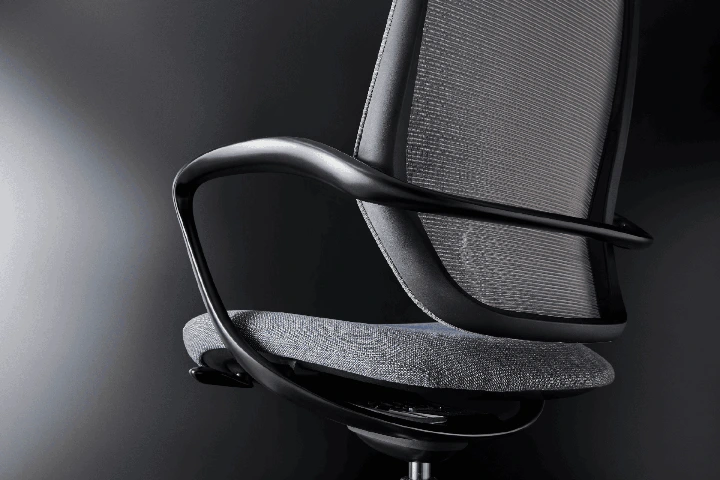
A well-engineered office chair is not a luxury item in the way a premium coffee machine is a luxury item. It is a functional tool. One that, when designed properly, actively supports the body through the demands of a working day rather than working against it.
The distinction between a budget chair and a genuinely premium office chair is not primarily aesthetic. It is mechanical and anatomical. Adjustability that fits the individual rather than approximating a standard. Lumbar support that can be positioned to meet the actual curve of the actual spine of the actual person sitting in it. Seat depth that accommodates different leg lengths without creating pressure behind the knee. A tilt mechanism that allows the body to move naturally rather than locking it into a single fixed posture.
These are engineering choices. They have real effects on real bodies. And those bodies belong to your people.
What Good Seating Actually Looks Like
A premium office chair earns that description through a combination of factors that are worth understanding before making any investment.
Independent certification is the clearest signal of genuine quality.
Chairs that have been tested by recognised third-party bodies have been evaluated for structural integrity, durability, and safety under real working conditions. This is meaningfully different from marketing language applied to an untested product.
Warranty length is another reliable indicator. Manufacturers who offer decade-long warranties on structural components are expressing confidence in their product that cannot be faked. A ten-year warranty is a commitment. A two-year warranty is a ceiling.
Material performance over time matters more than initial impression. A chair that feels comfortable on the first day but compresses and degrades within a year has failed at its primary function. Mesh that maintains tension, foam that retains its support, a base that remains stable under daily use: these are the standards that separate furniture built to last from furniture built to sell.
The Signal It Sends
There is one more dimension to this that is worth naming directly.
The furniture an organisation chooses for its people communicates something. It communicates how seriously the organisation takes the physical experience of the people who show up every day and do the work. Seating that has been chosen thoughtfully, that fits properly, that supports the body rather than ignoring it, sends a signal that is felt even when it is not spoken.
People notice when their environment respects them. They notice when it does not.
A premium office chair is not the whole of that signal. But it is a significant and daily part of it.
The Case Is Straightforward
The people in your organisation sit for most of their working day. The quality of what they sit in affects how they feel, how they focus, and how they perform. Better seating is not an indulgence. It is an investment with a return that shows up quietly, consistently, and compoundingly over time.
The only question worth asking is why it took this long to take it seriously.